It's Not Just a Comprehension Test: Demystifying Academic Literacy (AL)
Why "English is my home language" doesn't mean you'll ace the AL test. What academic literacy really measures and how to prepare.
The "first language" trap
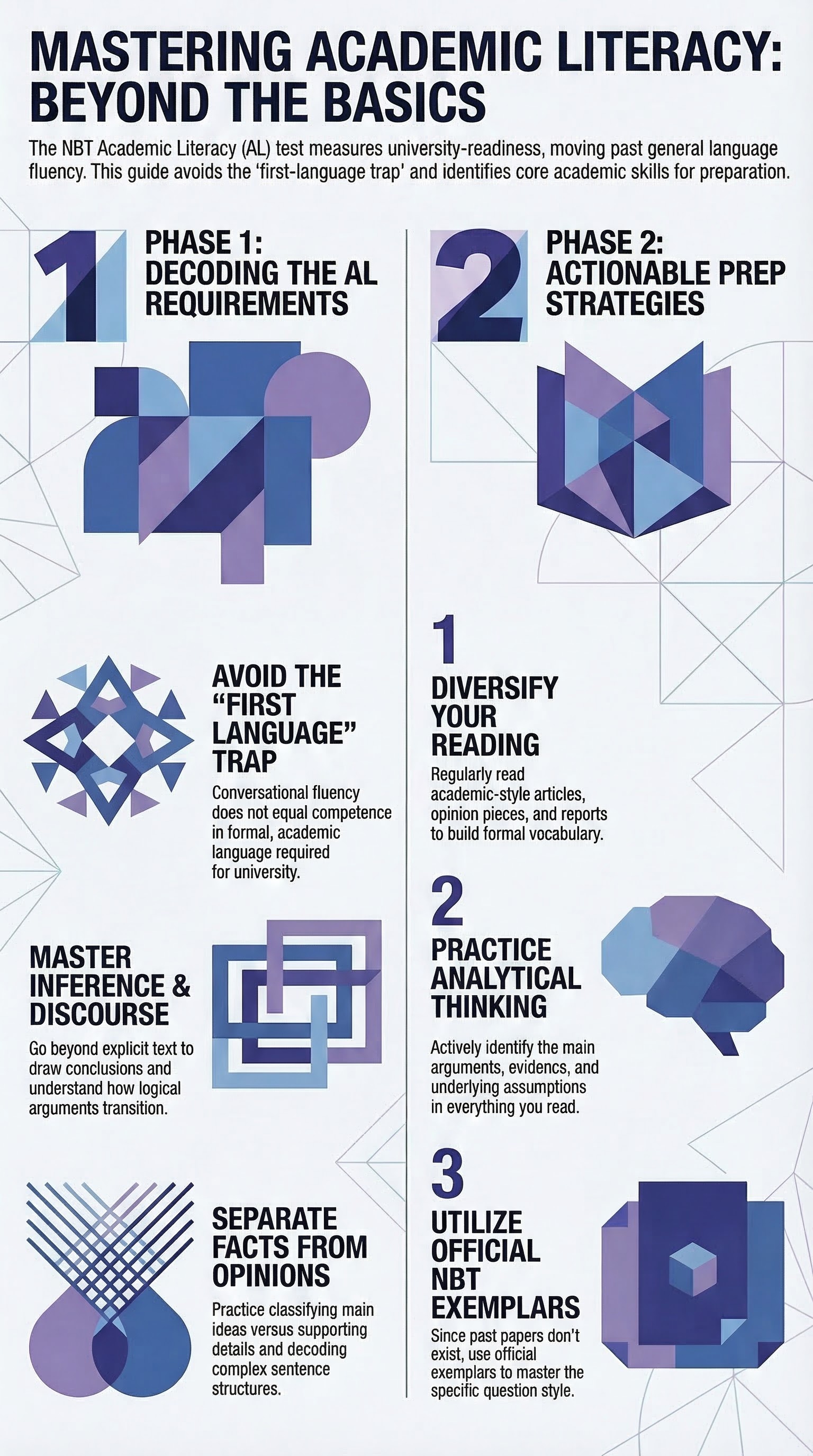
"English is my home language, so I don't need to study for the Academic Literacy test." This is one of the most dangerous myths about the NBTs. The conversational language skills you use in everyday life do not amount to competence in the formal, academic language required for university success. First-language speakers frequently underperform in the AL test because they underestimate it.
What does the AL test actually measure?
The NBT AL test measures your capacity to engage successfully with the demands of academic study. You will be presented with texts that mirror university-level reading, and you will be tested on your ability to:
- Make inferences: Draw conclusions based on what is implied, not just what is explicitly stated.
- Understand discourse: See the logical structure of an argument and how paragraphs transition and relate to one another.
- Separate the essential from the non-essential: Classify main ideas versus supporting details or opinions versus facts.
- Decode metaphor and syntax: Understand how sentence structure, word order, ambiguity, and idiomatic expressions affect meaning and emphasis.
Your high matric mark in English or Afrikaans means you are great at general language abilities, but the NBT tests strictly your academic literacy readiness.
How to prepare for AL
Read widely: academic-style articles, opinion pieces, and reports. Practise identifying main arguments, evidence, and assumptions. Work with the official NBT exemplars so you get used to the question style and the level of inference required. There are no past papers, so exemplars and broad reading are your best preparation.
Ready to put this into practice?
Our NBT courses are designed around the same strategies and content areas—with practice questions, exemplar-style tasks, and no-calculator drills.
View courses