The AQL Quantitative Literacy (QL) Section: What It Tests and How to Prepare
A deep dive into the QL part of the AQL test: interpreting graphs and tables, ratios and percentages, shape and rate, no calculator, and exemplar-style practice.
What Quantitative Literacy is
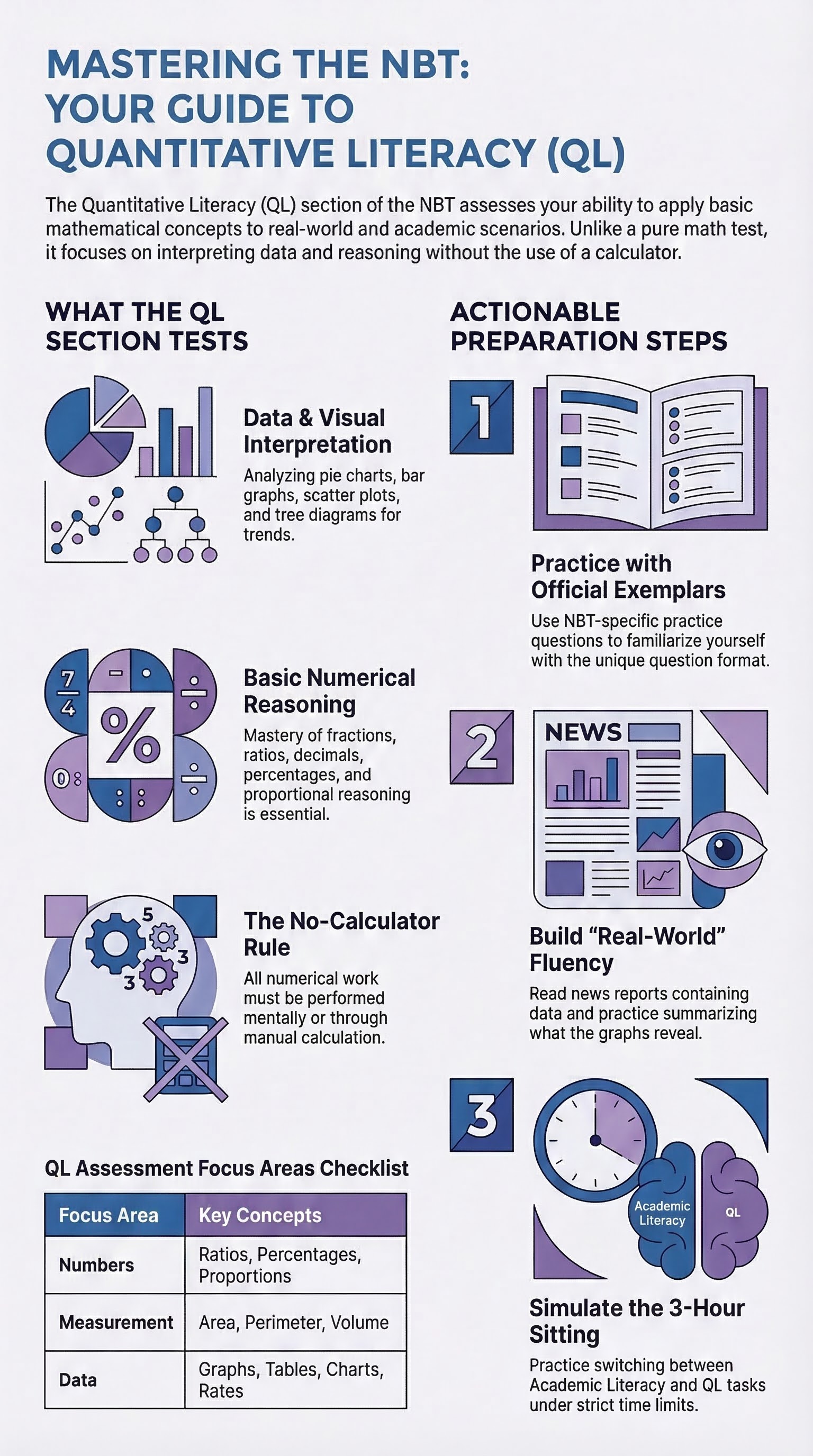
The AQL test has two parts: Academic Literacy (AL) and Quantitative Literacy (QL). QL tests your ability to solve problems using basic quantitative information—the kind you will meet in real-world and academic contexts. It is similar in spirit to Mathematical Literacy: reading data, not doing abstract calculus.
What QL tests
- Interpreting tables, graphs, and charts: pie charts, bar graphs, line graphs, scatter plots, tree diagrams, and similar.
- Basic numerical concepts: fractions, ratios, decimals, percentages, and proportional reasoning.
- Shape and dimension: area, perimeter, volume, and simple geometric reasoning.
- Changes and rates: interpreting trends, growth, and "how much more or less."
No calculator
Calculators are not allowed in the QL section. Questions use numbers that can be managed with mental arithmetic and estimation. Practise working without a calculator so you are comfortable on the day.
How to prepare
Use the official NBT exemplars for QL-style questions. Read articles and reports that include graphs and tables (e.g. news, reports) and practise summarising the data and answering "what does this show?" Build fluency with fractions, ratios, and percentages. Our AQL preparation materials include QL practice that mirrors this kind of thinking.
QL sits alongside Academic Literacy in the same 3-hour AQL test. You will switch between reading comprehension and quantitative tasks, so practising both in one sitting (under time limits) will help you feel ready. Remember: no calculator in QL, so all numerical work is by hand or in your head.
Ready to put this into practice?
Our NBT courses are designed around the same strategies and content areas—with practice questions, exemplar-style tasks, and no-calculator drills.
View courses