AQL vs MAT: Core Differences and What Each Test Actually Measures
A clear comparison of the two NBT tests: who writes them, when they are written, and what each measures so you can plan your preparation.
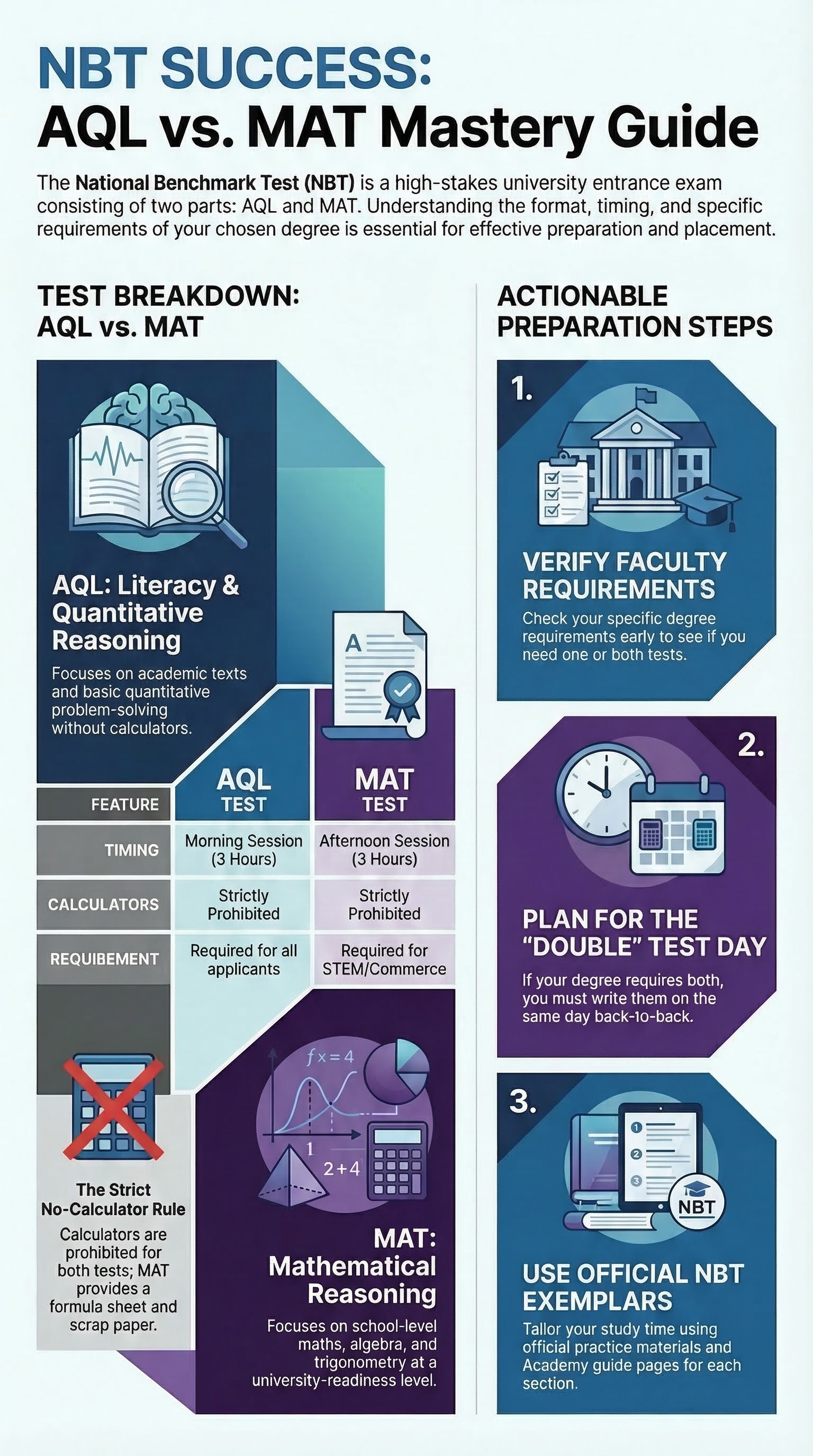
The two NBT tests at a glance
There are two NBTs: the Academic and Quantitative Literacy (AQL) test and the Mathematics (MAT) test. Both are multiple-choice and both are written on the same day if your degree requires both—AQL in the morning, MAT in the afternoon. You cannot write them on different days.
The AQL test
Everyone applying to university writes the AQL test. It is a 3-hour morning exam in timed sections (about 25–30 minutes each). It has two parts: Academic Literacy (AL) and Quantitative Literacy (QL). AL tests your ability to engage with academic texts: deriving meaning from context, understanding argument structure, making inferences, and separating main ideas from supporting detail. QL tests your ability to solve problems using basic quantitative information: interpreting tables, graphs, and charts; working with fractions, ratios, decimals, and percentages; and reasoning about shape, dimension, and rates. Calculators are not allowed.
The MAT test
You only write the MAT test if you are applying for a degree that requires Mathematics (e.g. Engineering, Medicine, Science, Commerce). It is a 3-hour afternoon exam. It evaluates your understanding of school-level maths at a university-readiness level: algebraic processes, functions and graphs, basic trigonometry, spatial perception, data handling, and logical reasoning. Calculators are strictly prohibited; a formula sheet and scrap paper are provided. The test uses four cognitive levels from recall to complex problem-solving.
Why the distinction matters
If your programme requires both tests, you must prepare for both. AQL focuses on literacy and quantitative reasoning; MAT focuses on mathematical reasoning and application. Use the official NBT exemplars and our guide pages to tailor your preparation to each test.
Check your faculty's requirements early. Some degrees need only AQL; others need AQL and MAT. Once you know which tests you are writing, you can plan your study time and test date so that your results are ready before your university deadlines.
Ready to put this into practice?
Our NBT courses are designed around the same strategies and content areas—with practice questions, exemplar-style tasks, and no-calculator drills.
View courses