Beware the "Distractor": How NBT Multiple-Choice Questions Are Designed to Trap You
NBT multiple-choice isn't "easy"—wrong answers are built from common mistakes. Why scaffolding is missing and how to avoid the distractor trap.
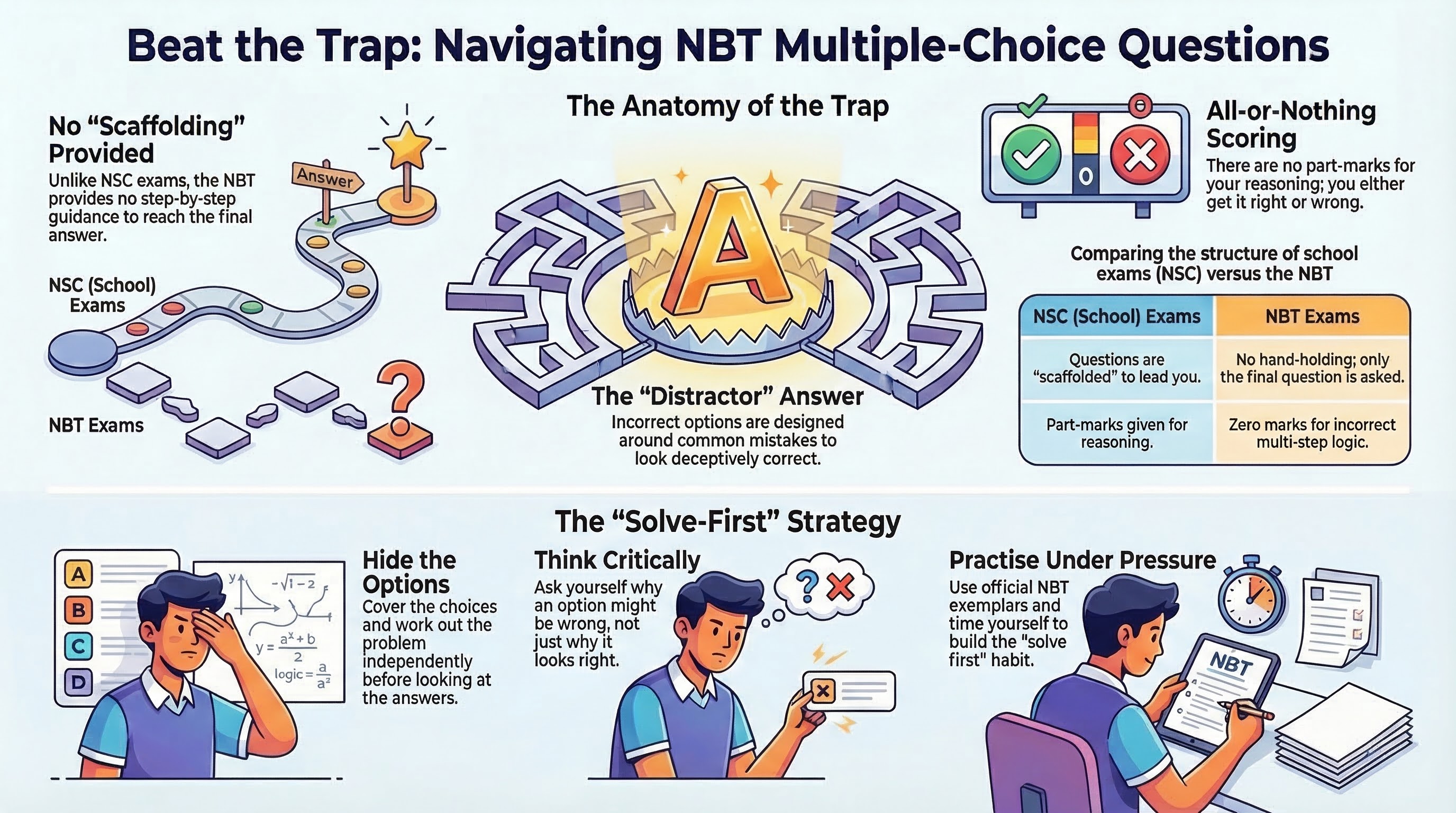
The myth of "easy" multiple choice
Many learners hear "multiple choice" and breathe a sigh of relief. But the NBT is not your average multiple-choice test. There are no part-marks for your reasoning or workings. You either get it right or you don't.
The missing "scaffolding"
In a standard National Senior Certificate (NSC) exam, questions are often "scaffolded" to guide you to the answer. An NSC paper might say: "Calculate the gradient of AC. Hence, determine the equation of BN." The NBT provides no such hand-holding. You will simply be given a sketch and asked: "The equation of BN is..." You have to figure out the multi-step logical path yourself.
The distractor trap
The NBT test-makers spend years fine-tuning their questions. The incorrect options (the distractors) are not just random numbers; they are deliberately designed around common mathematical misconceptions. If you make a common, careless error, you will likely see your incorrect answer staring back at you in the options, trapping you into thinking you got it right.
The strategy
Read the question carefully, hide the options, and work out the problem before you look at the choices provided. If you have a solid answer in mind, you are less likely to be swayed by a distractor that looks plausible. When you do look at the options, treat each one critically—ask yourself why it might be wrong, not only why it might be right.
Practise this approach with the official NBT exemplars and under timed conditions. Building the habit of "solve first, then match" will serve you across both the AQL and MAT tests.
Ready to put this into practice?
Our NBT courses are designed around the same strategies and content areas—with practice questions, exemplar-style tasks, and no-calculator drills.
View courses