How Universities Use the NBT to Design Foundation Courses
How the NBT project helps universities identify at-risk students and develop foundation courses and support programmes so more students succeed.
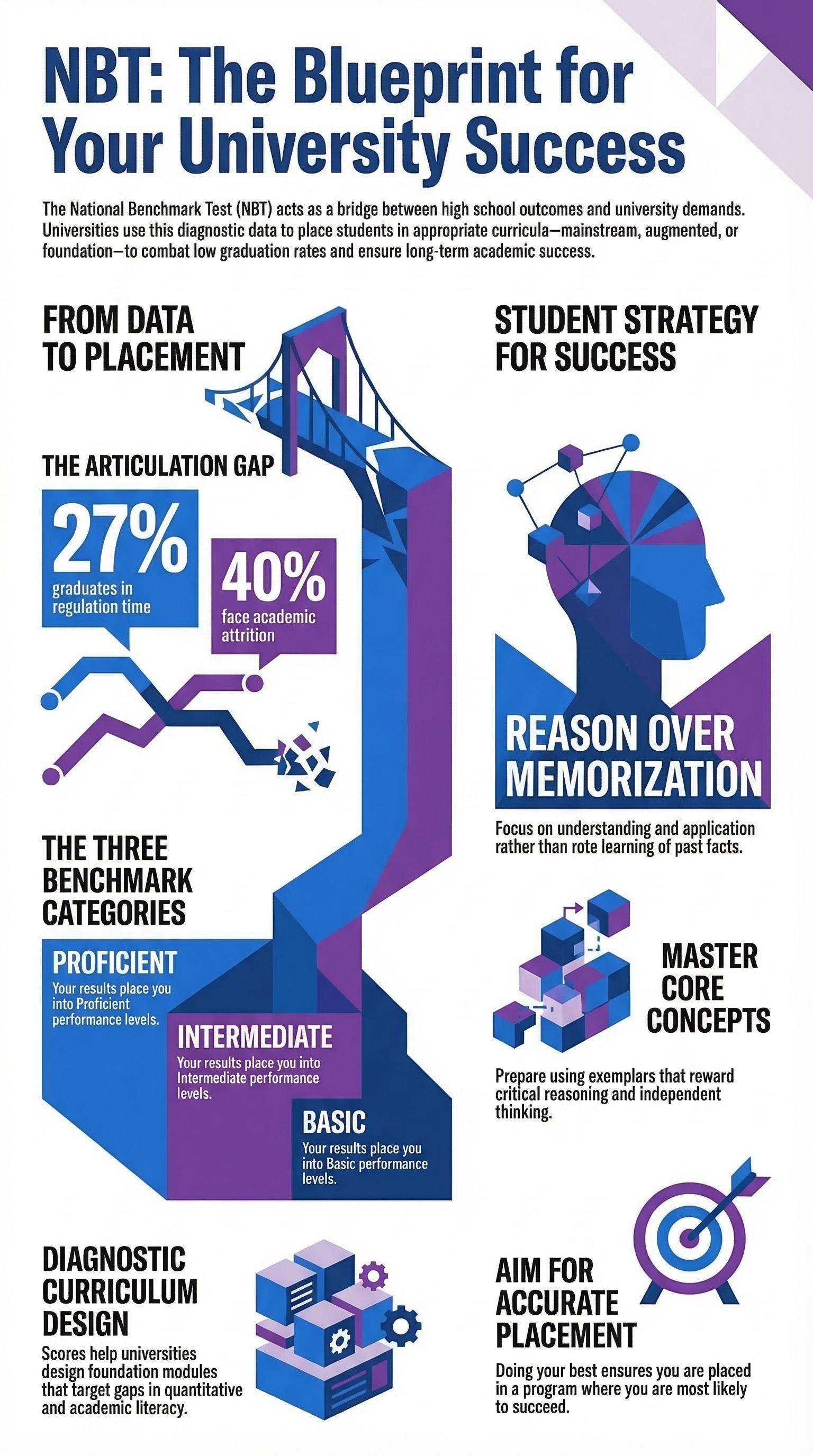
Why universities need diagnostic data
South African universities face an articulation gap: school-leaving outcomes do not always match the demands of first-year courses. Graduation in regulation time sits at around 27%, with attrition at roughly 40%. To improve throughput, institutions need to know which students are ready for mainstream study and which need extra support before they fail.
The NBT as a diagnostic tool
The NBT project provides supplementary data alongside the NSC. By placing you into a Proficient, Intermediate, or Basic benchmark category, universities gain critical diagnostic information. This allows them to identify students who are at risk and to place them into appropriate foundation courses, augmented curricula, or support programmes before they struggle or drop out.
How foundation courses and curricula are developed
Institutions use NBT results to see where the gaps are—for example, in quantitative literacy, academic literacy, or mathematics. They can then design or adjust foundation modules, extended programmes, and bridging courses that target those areas. The goal is to close the gap between school-level outcomes and the independent, critical, and thoughtful reasoning required at university, so that more students actually graduate.
What this means for you
Your NBT score is not only used for admission; it can determine the type of support or programme you are placed into. Doing your best on the NBT helps universities place you where you are most likely to succeed. If you are placed in a foundation or extended programme, it is to give you the best chance of completing your degree.
There are no past papers to study from, so preparation should focus on core concepts, exemplars, and the kind of thinking the tests reward—understanding, application, and reasoning rather than memorisation. Our courses are designed around exactly that approach.
Ready to put this into practice?
Our NBT courses are designed around the same strategies and content areas—with practice questions, exemplar-style tasks, and no-calculator drills.
View courses