Your MAT Course Roadmap: The Six Modules Every NBT Maths Learner Should Cover
A full NBT MAT course structure: orientation (format, no calculators, cognitive levels) plus six modules from algebraic processes to logical reasoning and test strategy.
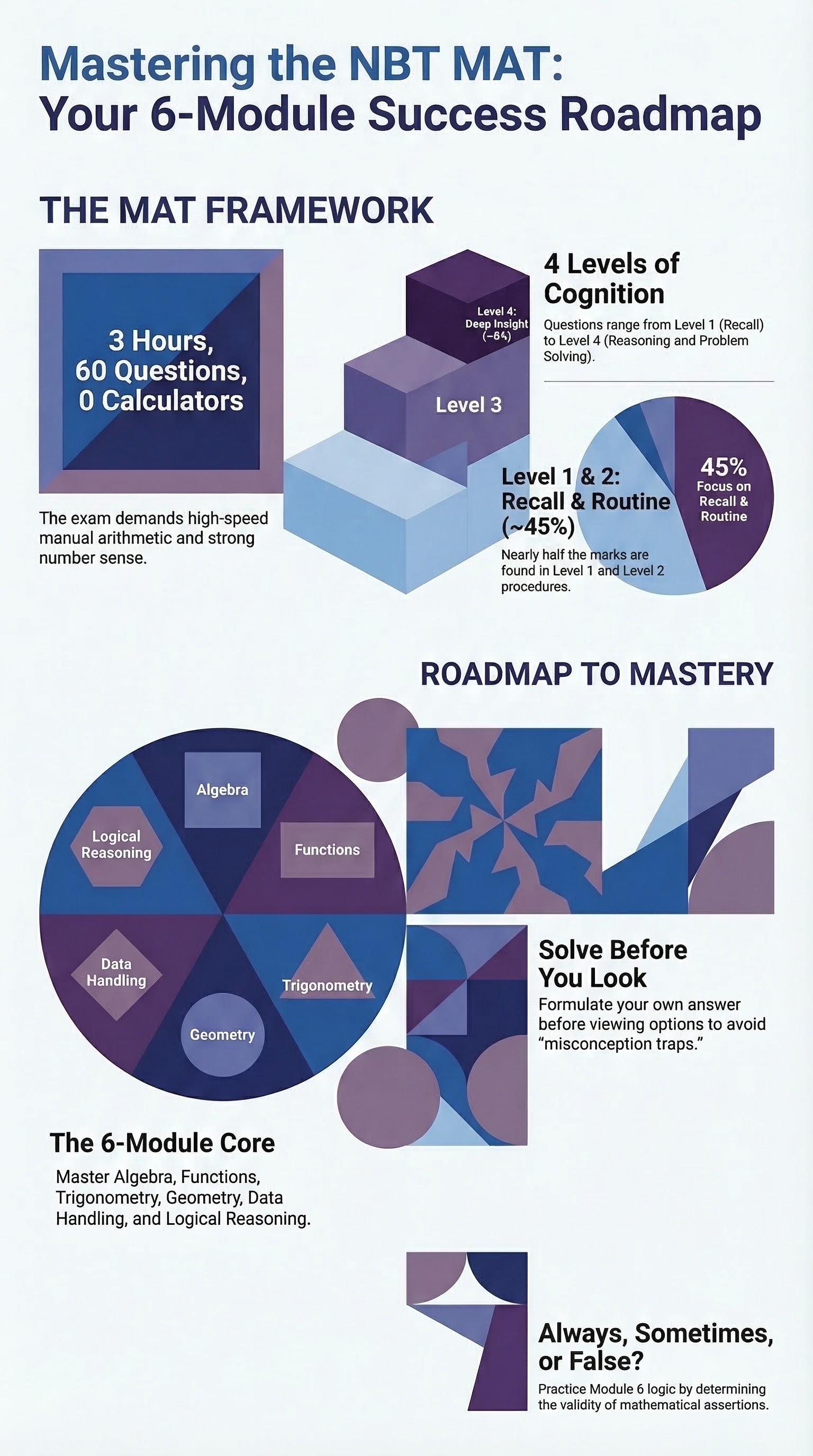
Course orientation: understanding the MAT test
The MAT test is a 3-hour, timed, multiple-choice assessment. Questions do not cue or "scaffold" you into the correct reasoning—you must decide on the appropriate mathematical approach yourself. Calculators are strictly prohibited; the course must emphasise developing number sense, manual arithmetic, and the ability to estimate. Prepare for four cognitive levels: knowing (level 1), routine procedures (level 2), complex procedures (level 3), and reasoning/problem solving (level 4). About 45% of the test involves recall and simple procedures, while about 8% requires deep insight and complex problem-solving.
Module 1: Problem solving, modelling, and algebraic processes
- Number sense & basics: Manipulations and simple calculations with integers, rational, and irrational numbers.
- Algebraic manipulation: Simplifying, factorising, completing the square, and solving expressions, equations, and inequalities.
- Exponents & logarithms: Operations with surds, exponents, and logarithms, including solving exponential equations.
- Patterns & sequences: Pattern recognition, geometric and arithmetic sequences, series, and sigma notation.
- Financial mathematics: Compound interest, appreciation, and future value (focus on formula construction rather than final calculated answers).
- Relationships: Ratios and percentages.
Module 2: Functions and graphs
- Function basics: Notation, substitution, domain, and range.
- Graph analysis: Intercepts, turning points, asymptotes, and linking graphs to equations or inequalities.
- Transformations: Translations, reflections, rotations, and inverses of functions.
- Differential calculus: Critical points, increasing/decreasing functions, and tangents for simple linear and non-linear functions.
Module 3: Basic trigonometry
- Fundamentals: Sine, cosine, and tangent ratios; basic calculations without a calculator.
- Trig graphs: Domain, range, period, amplitude, and transformations.
- Equations & identities: Solving trig equations, identities, reduction formulae, special and compound angles.
- Application rules: Area, sine, and cosine rules.
- Spatial problems: 2D and 3D geometric applications.
Module 4: Spatial perception and geometry
- 2D and 3D objects: Properties of circles, rectangles, trapeziums, spheres, cones, pyramids.
- Measurements: Perimeter, area, volume (including composite figures), scale factors, and transformations.
- Analytic geometry: Linking geometric and algebraic properties in the Cartesian plane.
- Circle geometry: Cyclic quadrilaterals, tangents, chords, and angles in a circle.
Module 5: Data handling and probability
- Data representation: Histograms, line graphs, pie charts, ogives, box-and-whisker plots.
- Central tendency: Mean, median, mode, standard deviation, and the impact of outliers.
- Probability: Probability rules, tree diagrams, and Venn diagrams.
Module 6: Logical reasoning and test strategy
The MAT also tests logical reasoning: making conjectures and determining the validity of mathematical assertions. You may need to decide whether a statement is always true, sometimes true, or false, and to follow a short chain of logical steps.
Your test strategy matters as much as your maths. Read each question carefully, attempt to solve it before looking at the options, and be aware that incorrect options often reflect common mathematical misconceptions. Practise under timed conditions so you learn to pace yourself across roughly 60 questions in 3 hours.
Ready to put this into practice?
Our NBT courses are designed around the same strategies and content areas—with practice questions, exemplar-style tasks, and no-calculator drills.
View courses