Mental Maths and Number Sense: Preparing for the NBT Without a Calculator
Practical ways to build the skills the NBT rewards: estimation, fractions, percentages, formulae vs final answers, and daily no-calculator practice.
Why number sense matters
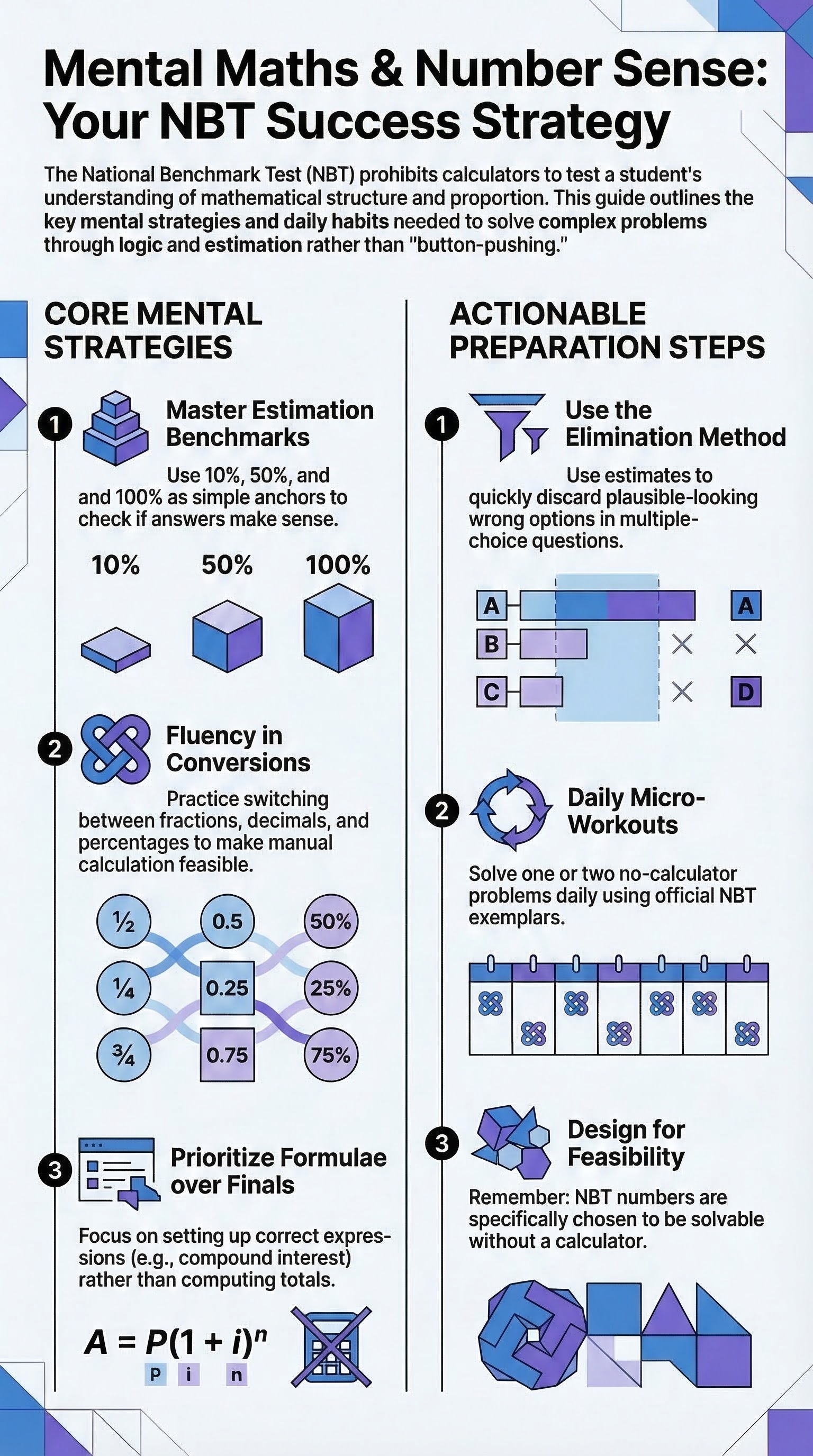
The NBT MAT and the Quantitative Literacy part of the AQL do not allow calculators. The tests are designed to see whether you understand relative size, proportion, and structure—not whether you can tap numbers into a machine. Building mental maths and number sense is therefore central to preparation.
Estimation is your friend
Get comfortable estimating before you calculate. Round numbers, compare to simple benchmarks (e.g. 10%, 50%, 100%), and ask yourself whether an answer "makes sense." In multiple-choice, the wrong options are often there because they look plausible; a good estimate can help you eliminate them quickly.
Fractions, ratios, and percentages
Practise converting between fractions, decimals, and percentages in your head. Work with simple ratios and scale factors. The test uses numbers that are chosen so manual calculation is feasible—so fluency with these basics goes a long way.
Formulae vs final answers
In financial maths (e.g. compound interest), the NBT often asks for the correct expression or formula (e.g. 1000(1,06)^5) rather than the final rand amount. Focus on setting up the right relationship; you may not need to compute the end result. This pairs with the no-calculator rule: they are testing understanding, not button-pushing.
Daily practice
Do a little mental maths every day: quick arithmetic, estimation, and one or two no-calculator problems. Use the official NBT exemplars and any practice material that forces you to work without a calculator. Over time, your speed and confidence will improve—and that is exactly what the test is measuring.
The NBT is not designed to catch you out with impossible arithmetic. The numbers are chosen so that manual calculation is feasible. Your job is to build enough fluency that you can work through them calmly under time pressure. Start early, practise consistently, and you will be ready.
Ready to put this into practice?
Our NBT courses are designed around the same strategies and content areas—with practice questions, exemplar-style tasks, and no-calculator drills.
View courses