Basic, Intermediate, and Proficient: What Your NBT Benchmark Really Means
How NBT achievement levels differ from NSC results and what each benchmark—Basic, Intermediate, and Proficient—means for university placement and support.
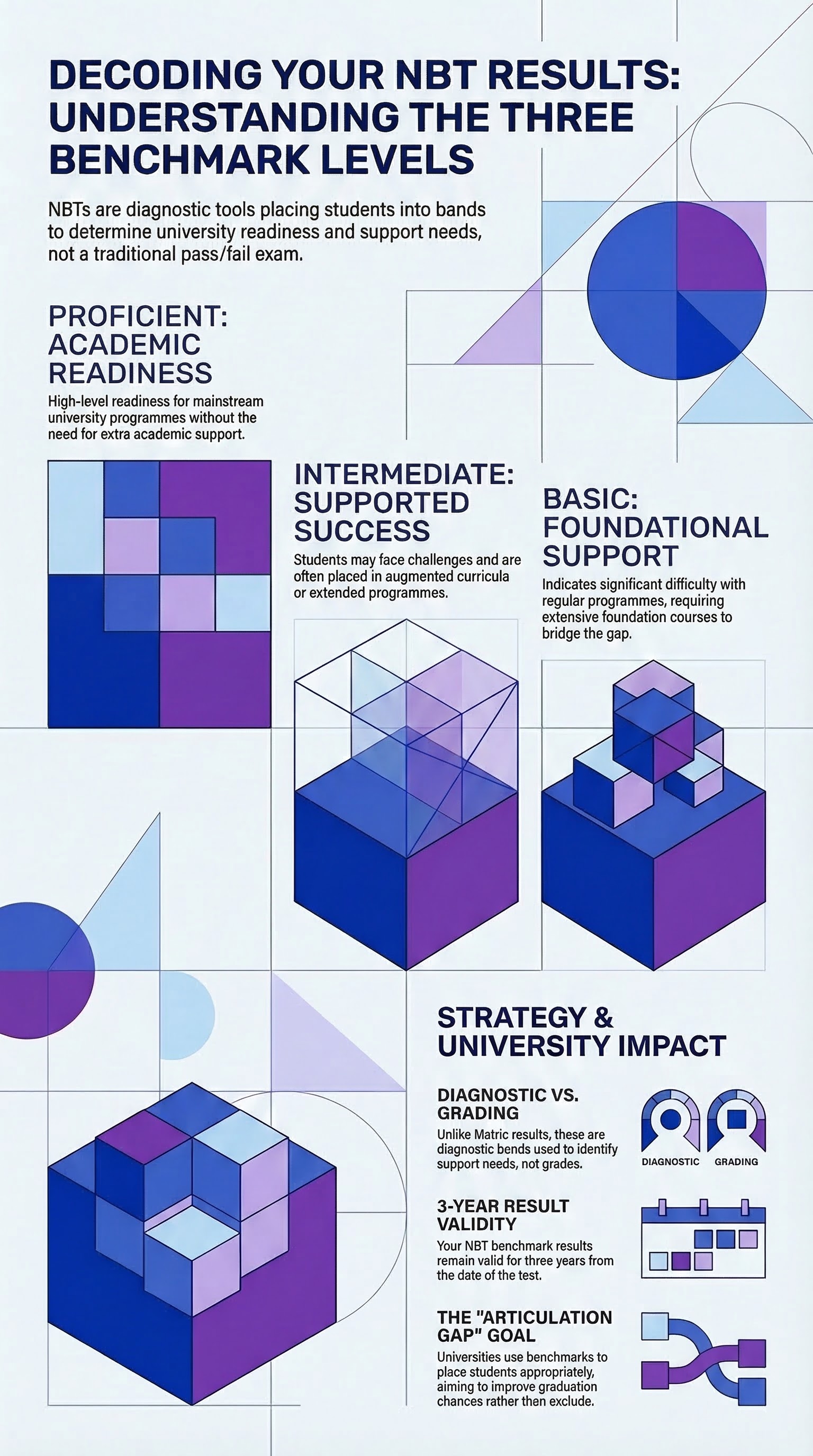
NBT levels are not the same as NSC results
You cannot "pass" or "fail" the NBTs. Your performance places you into one of three benchmark categories. These are not grades like your matric results; they are diagnostic bands that tell universities how ready you are for the demands of tertiary study and whether you are likely to need extra academic support.
Proficient
You demonstrate a high level of academic readiness and should be able to cope with the demands of mainstream university programmes without extra support. Universities treat this as readiness for regular degree programmes.
Intermediate
You may face challenges in certain academic areas. Universities often place students in this band into supported mainstream or extended programmes. You may need some form of academic assistance or augmented curricula so you can succeed.
Basic
You will likely experience significant difficulty with regular academic programmes and will require extensive foundational support. Universities use this to identify students who need foundation courses or extended programmes before they can cope with mainstream first-year content.
How universities use these levels
By analysing your NBT benchmark, institutions can proactively place you into appropriate foundation courses or support programmes. The goal is to close the articulation gap and improve your chances of graduating, rather than to exclude you. How long a score remains usable is set by each university—confirm on nbt.ac.za and on your faculty admissions pages.
If you are in the Intermediate or Basic band, do not assume you have "failed." Many students in these bands are placed into extended or foundation programmes and go on to complete their degrees successfully. The NBT is there to help universities support you, not to shut the door.
Ready to put this into practice?
Our NBT courses are designed around the same strategies and content areas—with practice questions, exemplar-style tasks, and no-calculator drills.
View courses