NBT for Engineering and Science: MAT Focus and What to Expect
Engineering and Science programmes require the MAT test. What topics and cognitive levels to expect, the no-calculator rule, and how to prepare for a maths-heavy application.
MAT is central to your application
If you are applying for Engineering, Science, or other maths-heavy degrees (e.g. BSc, BEng), you will need to write both the AQL and the MAT test. The MAT carries significant weight because these programmes depend on mathematical reasoning, algebra, functions, and problem-solving. Prepare for the MAT as a priority, without neglecting AQL.
What the MAT covers
- Algebraic processes: number sense, manipulation, surds, exponents, logarithms, sequences, financial maths.
- Functions and graphs: domain, range, transformations, calculus applications.
- Basic trigonometry: identities, equations, sine/cosine/area rules, 2D and 3D applications.
- Spatial perception: 2D and 3D geometry, analytic geometry, circle geometry.
- Data handling and probability: interpretation of data, central tendency, probability.
- Logical reasoning: deductions and validity of mathematical statements.
No calculator, four cognitive levels
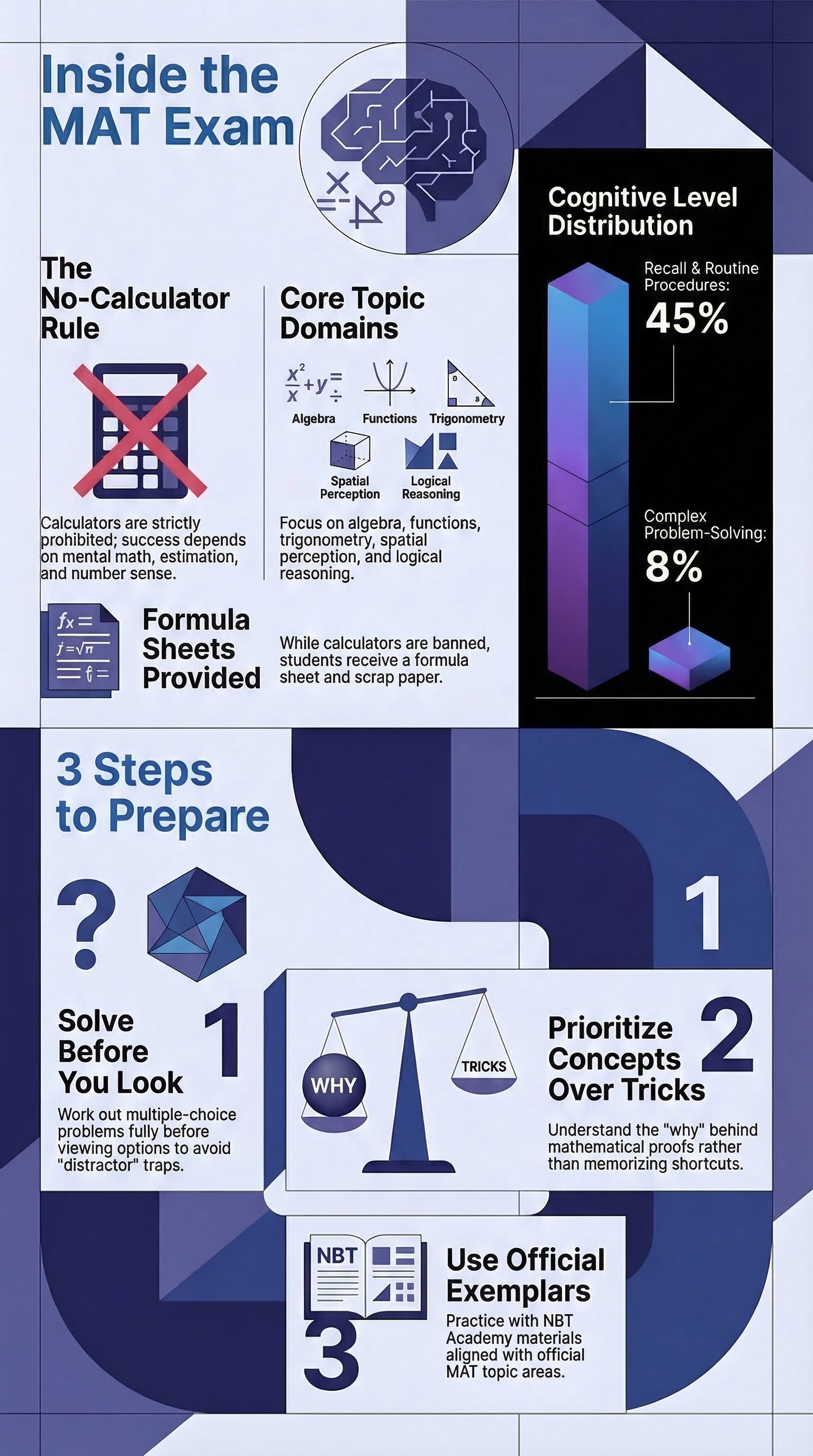
Calculators are strictly prohibited in the MAT. Questions are set so they can be done with number sense, estimation, and manual arithmetic. You get a formula sheet and scrap paper. The test uses four cognitive levels: from recall and routine procedures (about 45% of the test) to complex procedures and problem-solving (about 8%). Prepare by practising without a calculator and by understanding concepts, not just steps.
How to prepare
Use the official NBT exemplars, revise the MAT topic areas above, and build mental maths and estimation. Work through multiple-choice questions by solving the problem before looking at the options—wrong answers are often built from common mistakes. Our MAT course and practice materials are aligned with these areas and the no-calculator, strategy-focused approach the test demands.
Engineering and science faculties take the MAT seriously because your degree will build on mathematical reasoning every day. Investing in MAT preparation—concepts, not just tricks—will pay off both for your NBT score and for your first year at university.
Ready to put this into practice?
Our NBT courses are designed around the same strategies and content areas—with practice questions, exemplar-style tasks, and no-calculator drills.
View courses