NBT for Parents: What the Scores Mean and How to Support Your Child
A short guide for parents: why a high matric mark can sit next to a lower NBT score, what Proficient/Intermediate/Basic mean, and how to support your child without adding pressure.
Why high matric marks don't always match NBT scores
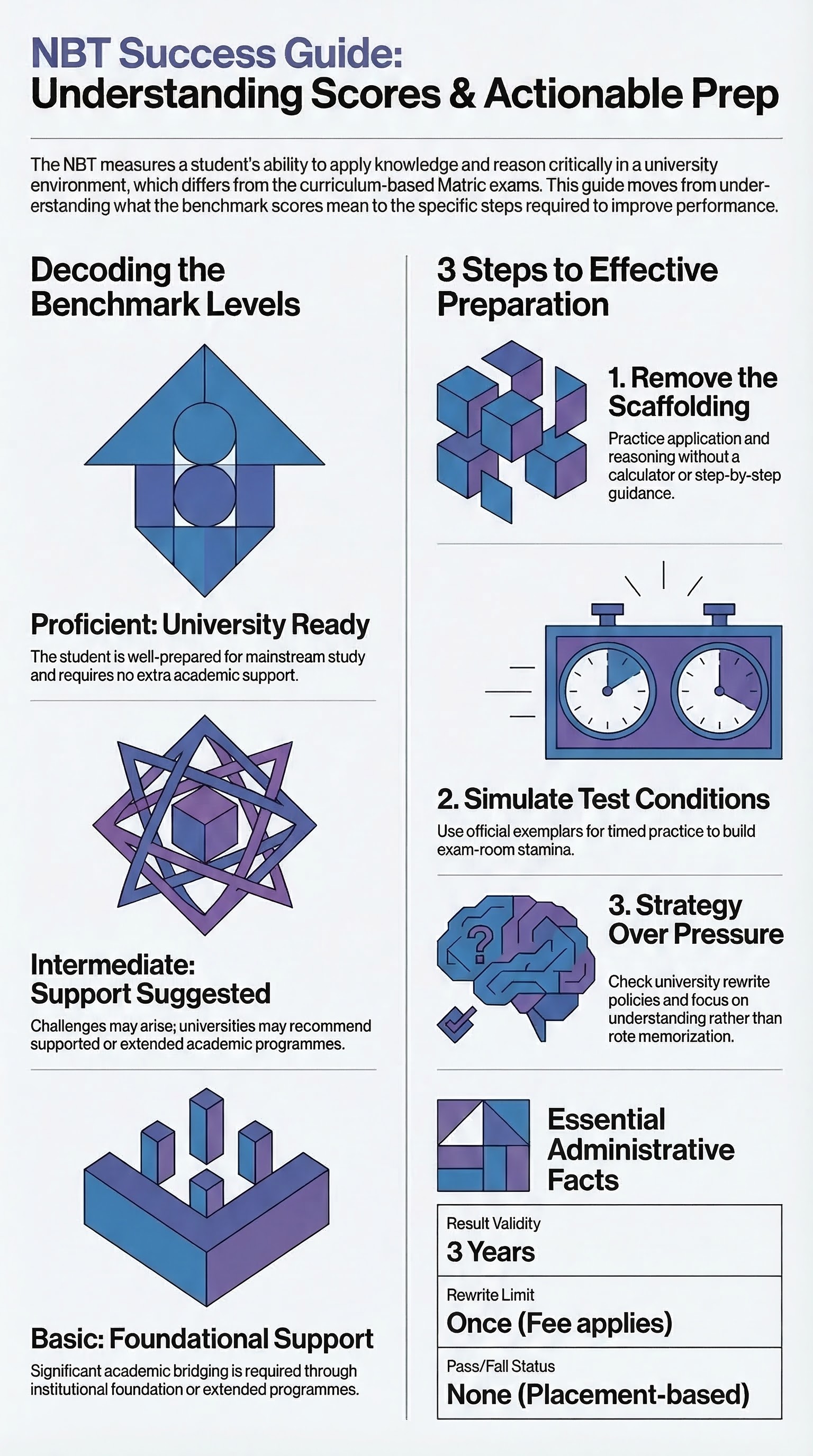
"My child gets distinctions in Matric Maths. Why did they get a low NBT score?" This is one of the most common questions from parents. The NSC exams and the NBTs measure different things. Matric rewards curriculum mastery, past-paper practice, and often step-by-step (scaffolded) questions. The NBT tests application, critical thinking, and reasoning without that scaffolding—and without a calculator. A strong matric result shows they know the content; the NBT shows whether they can apply it in the way university will demand.
What the three benchmark levels mean
- Proficient: Your child is well-prepared for mainstream university study and typically won't need extra academic support.
- Intermediate: They may face challenges in some areas; universities often offer supported or extended programmes to help them succeed.
- Basic: They are likely to need substantial foundational support; many institutions place such students in foundation or extended programmes so they can build up before regular first-year content.
You can't "fail" the NBT
The NBT does not give a pass/fail. It places your child in one of these three bands so universities can make better admission and placement decisions. A result in Intermediate or Basic is not a rejection—it helps the institution offer the right level of support. How long a result counts varies by institution; the NBT project allows up to two writes per cycle (full fee each time) if a rewrite is appropriate and the university accepts it.
How to support without pressuring
Encourage preparation that focuses on understanding and practice under test conditions (no calculator, timed, using exemplars). Avoid framing the NBT as a single make-or-break event; it is one part of the application. If they are disappointed with a score, listen first, then help them check university policies (e.g. whether a rewrite is accepted) and consider whether a foundation or extended programme might be a good fit. Your calm, informed support matters more than extra pressure.
You can point them to the official NBT website for exemplars and to our guide and blog for clear explanations of what the tests measure and how results are used. The more they understand the purpose of the NBT, the less anxious they—and you—may feel.
Ready to put this into practice?
Our NBT courses are designed around the same strategies and content areas—with practice questions, exemplar-style tasks, and no-calculator drills.
View courses