The National Benchmark Tests Project: How NBTs Support University Placement
What the NBT project is for, how it supports student placement, the core differences between AQL and MAT, and how universities use NBT data to develop foundation courses.
What the NBT project does
The National Benchmark Tests (NBTs) serve as a critical assessment tool designed to evaluate the academic readiness of prospective university students in South Africa. Established to provide supplementary data alongside secondary school results, these assessments help higher education institutions place learners into suitable academic programmes. The evaluation is divided into two primary examinations focusing on Academic Literacy, Quantitative Literacy, and Mathematics proficiency. By measuring these core competencies, the project assists universities in identifying where curriculum adjustments or foundational support may be necessary. Ultimately, the tests bridge the gap between school-level outcomes and the rigorous demands of a tertiary learning environment.
How do the NBTs support student placement?
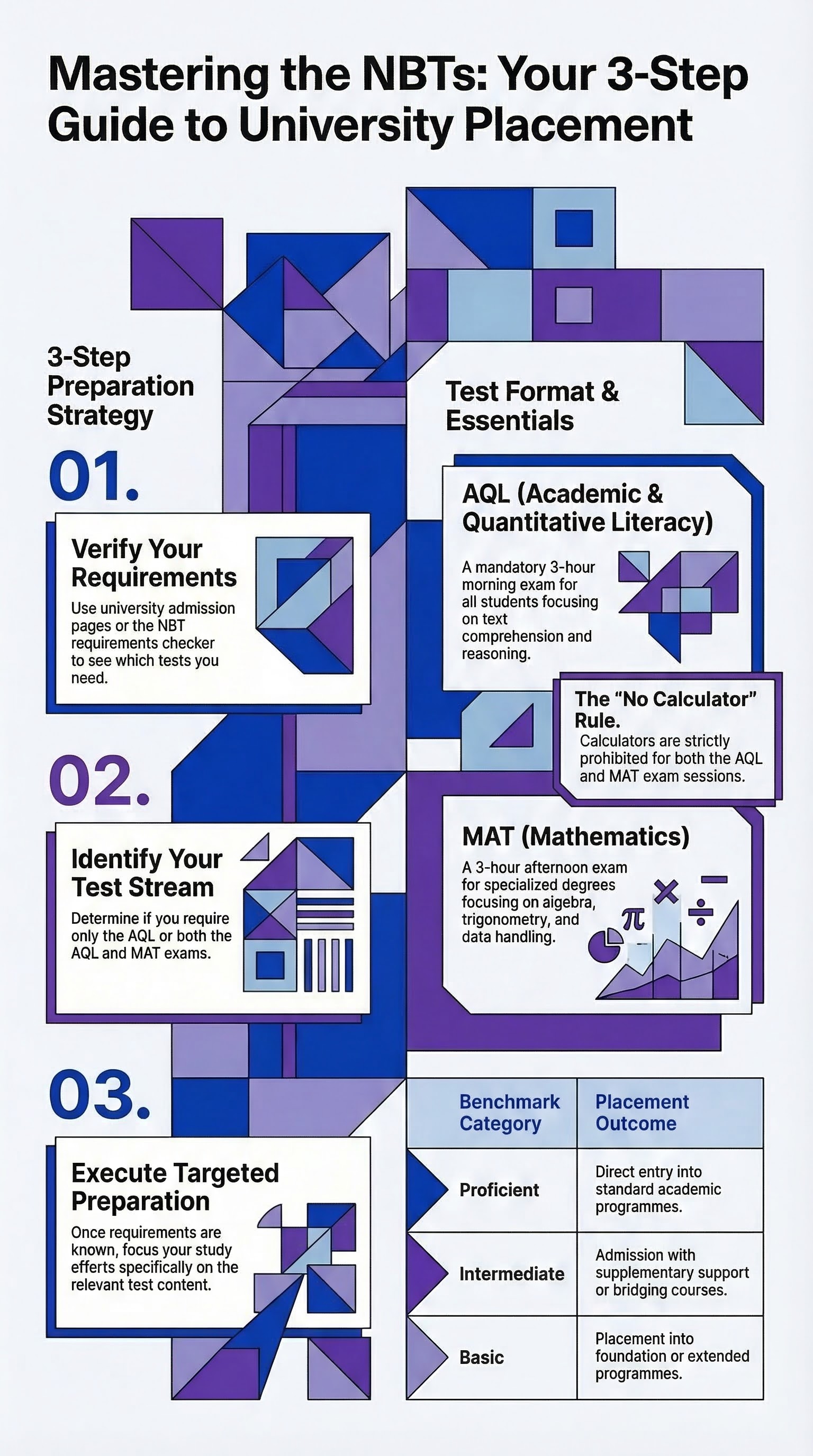
Universities use your NBT scores together with your National Senior Certificate (NSC) results to make admission decisions and to determine whether you will need extra academic support—such as bridging courses or extended programmes—once you are admitted. Your benchmark category (Proficient, Intermediate, or Basic) gives institutions critical diagnostic data so they can place you into the right programme and offer support where needed.
What are the core differences between the AQL and Mathematics tests?
The AQL (Academic and Quantitative Literacy) test is written by everyone applying to university. It is a 3-hour morning exam that measures your ability to understand academic texts, interpret graphs and tables, and perform basic quantitative reasoning. The MAT (Mathematics) test is a separate 3-hour afternoon exam, written only if your degree requires Mathematics (e.g. Engineering, Medicine, Science, Commerce). The MAT focuses on problem-solving, algebraic processes, functions and graphs, trigonometry, spatial perception, and data handling. Both are multiple-choice; calculators are prohibited in both.
How does the NBTP help universities develop foundation course curricula?
By identifying which learners fall into the Basic or Intermediate bands, universities can design and target foundation courses, augmented curricula, and support programmes. The NBT data helps institutions see where the articulation gap is largest and where extra teaching or scaffolding is needed so that students are more likely to succeed and graduate.
If you are unsure whether you need to write one or both tests, use your university's admissions pages or our NBT requirements checker. Once you know what is required, you can focus your preparation on the right test or tests.
Ready to put this into practice?
Our NBT courses are designed around the same strategies and content areas—with practice questions, exemplar-style tasks, and no-calculator drills.
View courses