The NBT Survival Guide: What to Know Before You Book
A single roadmap for South African applicants: what the NBT is, what AQL and MAT measure, when to write, how to register, pencil-and-paper vs online rules, results, and rewriting—grounded in official NBT project information.
What are the National Benchmark Tests (NBTs)?
The National Benchmark Tests have been part of South African university admissions since 2008. They measure academic readiness for tertiary study—not to replace your NSC (matric), but to complement it. Many universities use NBT scores together with school results to make admission decisions and to decide whether you may need extra academic support once you are accepted.
The tests are run by the National Benchmark Test Project, hosted at the University of Cape Town. Always treat www.nbt.ac.za and the official booking portal as the source of truth for dates, fees, and rules.
The two tests: AQL and MAT
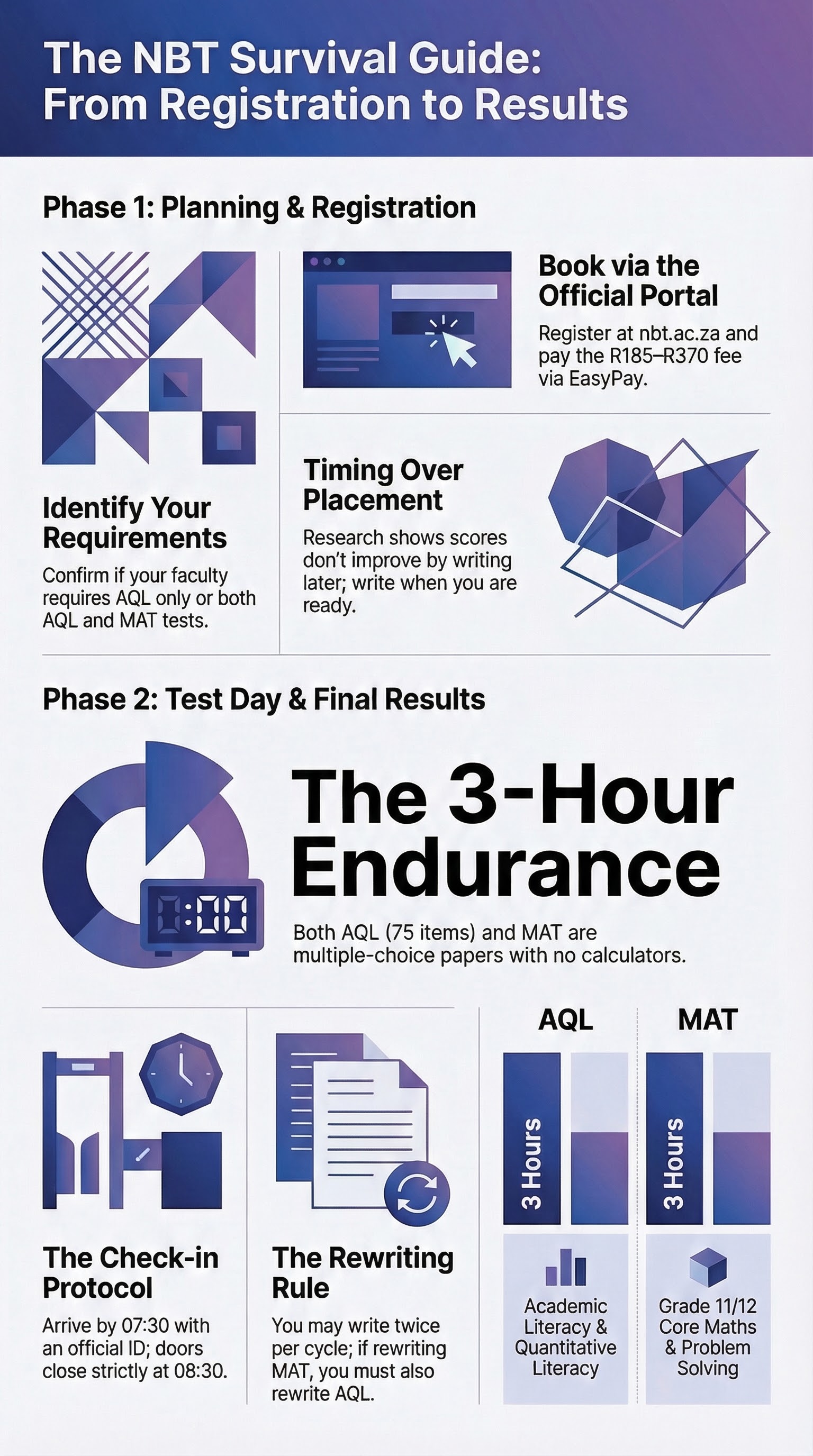
There are two separate papers. The Academic and Quantitative Literacy (AQL) test is a single three-hour multiple-choice paper taken by applicants to all programmes. It combines Academic Literacy (AL) and Quantitative Literacy (QL). The Mathematics (MAT) test is another three-hour multiple-choice paper for applicants to programmes that require mathematics. If you must write MAT, you write it on the same day as AQL—AQL in the morning and MAT in the afternoon, with a break between. You cannot write MAT on a different day or “arrive at midday” for MAT only.
- AQL (about 75 multiple-choice items in total): AL focuses on reading demanding texts, following arguments, vocabulary, and academic language use. QL focuses on numbers, graphs, tables, logical reasoning, and quantitative sense—without a calculator.
- MAT: Draws mainly on Grade 11 Core Mathematics (with some Grade 12 content), assessing problem-solving, functions, trigonometry, space and shape, probability, and modelling—all in multiple-choice format, no calculator.
Both papers span a range of difficulty (cognitive levels); easier items often appear earlier in a section. For the official description of content, see https://nbt.uct.ac.za/content/what-nbts
Do I need to write the NBT—and when?
Whether you need AQL only or AQL and MAT depends on each university and programme. Requirements change, so use your faculty’s latest prospectus and our NBT requirements checker on this site rather than relying on informal lists.
Tests usually run from late May until the first Saturday in January for the next intake cycle. NBT research indicates that writing later in the year does not give you a higher score than writing earlier—you should write when you are ready, but you must still meet every institution’s deadline. Some faculties (for example Health Sciences) expect scores as early as June or July.
If you apply to more than one institution or faculty, plan for the earliest deadline. You only write once per attempt; all institutions you apply to can request your results from the NBT project.
- Check your school calendar (exams, sports, holidays).
- Check closing dates for every programme you are considering.
- Match the language you register for to the language of instruction at your first-choice institution (see the NBT FAQ on languages).
What are the tests like in the room?
Both papers are multiple-choice; answers are marked on scanned answer sheets (“bubble sheets”). The AQL is written in timed sections (often around 25 minutes each). In the paper-based test, you typically work only within the current section and cannot flip back to earlier sections. The MAT is three hours without that sectional split.
Registration, fees, and booking rules
You register online (the process takes only a few minutes once you have your documents). You will need your South African ID or passport. Payment is through the Lesaka EasyPay system using the reference on your registration confirmation. For the latest fees, see the NBT website; the project has published AQL-only and AQL+MAT pricing (for example R185 / R370 for a recent cycle—always confirm the current year).
- Book only through the official site: https://nbtests.uct.ac.za/tests/register
- Your booking is for a specific date and venue (or online session). If you miss that session without an approved emergency, you must register again and pay again.
- You can usually change your booking online until the closing date shown on the test schedule for that date.
View published dates and venues here: https://nbt.ac.za/content/calendar-test-0
Where can I write? Online vs in person
You can write at venues across South Africa or, where offered, through the secure online NBT. Online and paper versions are designed to be equivalent, but online writers should book earlier in the cycle in case loadshedding or connectivity forces a retest. Some faculties publish exceptions for certain programmes (for example restrictions on using online results for specific health science streams)—read your faculty’s rules carefully.
Test day (pencil and paper): times, ID, and what to bring
- Check-in is from 07:30. Doors close at 08:30; after that you may not be admitted—plan to arrive early.
- Bring: South African ID or passport; pencils and eraser; water; lunch if you write both AQL and MAT.
- Do not bring calculators, dictionaries, or other aids unless the NBT has approved an accommodation.
- Without official ID you may be turned away. If you use a birth certificate instead, the NBT specifies police affidavit and photograph requirements—see the official test-day FAQ on www.nbt.ac.za.
For disabilities or special accommodations, use the official special-accommodation process (including timelines and medical documentation) via the NBT disability desk and forms on www.nbt.ac.za—do not assume a venue can arrange this on the day.
Languages
The NBT is offered in English and Afrikaans. You choose one language for the whole session—you cannot write AQL in one language and MAT in another. Pick the language that matches how you will study at university.
Results and how universities get them
According to the NBT project, institutions may receive scores about three weeks after you write, while your personal results are uploaded to your NBT account by the date shown on the official test schedule (often around four weeks). You log in with your ID number and the password you created at registration. You do not post results to universities yourself; they request them from the NBT project. You must tick consent during registration for results to be released to institutions.
Staff do not give results over the phone. If you cannot access your account, use the contact options on www.nbt.ac.za (e.g. nbt@uct.ac.za).
Rewriting and “past papers”
The NBT project allows you to write at most twice in a given cycle. If you rewrite MAT, you must rewrite AQL the same morning. You pay the full fee each time. Not every university will use your second score—check each faculty. If you rewrite, leave enough time between sessions for preparation and for results to reach your deadlines.
There are no official past papers; the tests are confidential. Use the official exemplar booklets on the NBT site and reputable practice that builds reading, quantitative reasoning, and no-calculator maths skills.
How NBT Academy fits in
We are not affiliated with the NBT project, but our courses and mock-style practice are built around the same skills the tests target: academic reading, quantitative literacy, and Core Maths reasoning under time pressure. Use this guide with the official site, then dive into our lessons and question banks when you are ready to prepare systematically.
Ready to put this into practice?
Our NBT courses are designed around the same strategies and content areas—with practice questions, exemplar-style tasks, and no-calculator drills.
View courses