Demystifying Quantitative Literacy (QL) – It is NOT Just "Maths Lit"
The QL section of the AQL test is not the same as school Mathematical Literacy. What QL actually measures: data, change and rates, shape and dimension, quantity and number—in a tertiary context.
The misconception
Many learners assume that the Quantitative Literacy (QL) section of the AQL test is identical to the school subject Mathematical Literacy. However, they serve different purposes. The NSC Mathematical Literacy exam tests if a school leaver has met the high school curriculum expectations. The NBT QL test, on the other hand, evaluates if a candidate is academically ready to manage the quantitative demands of tertiary education.
What does the QL test actually measure?
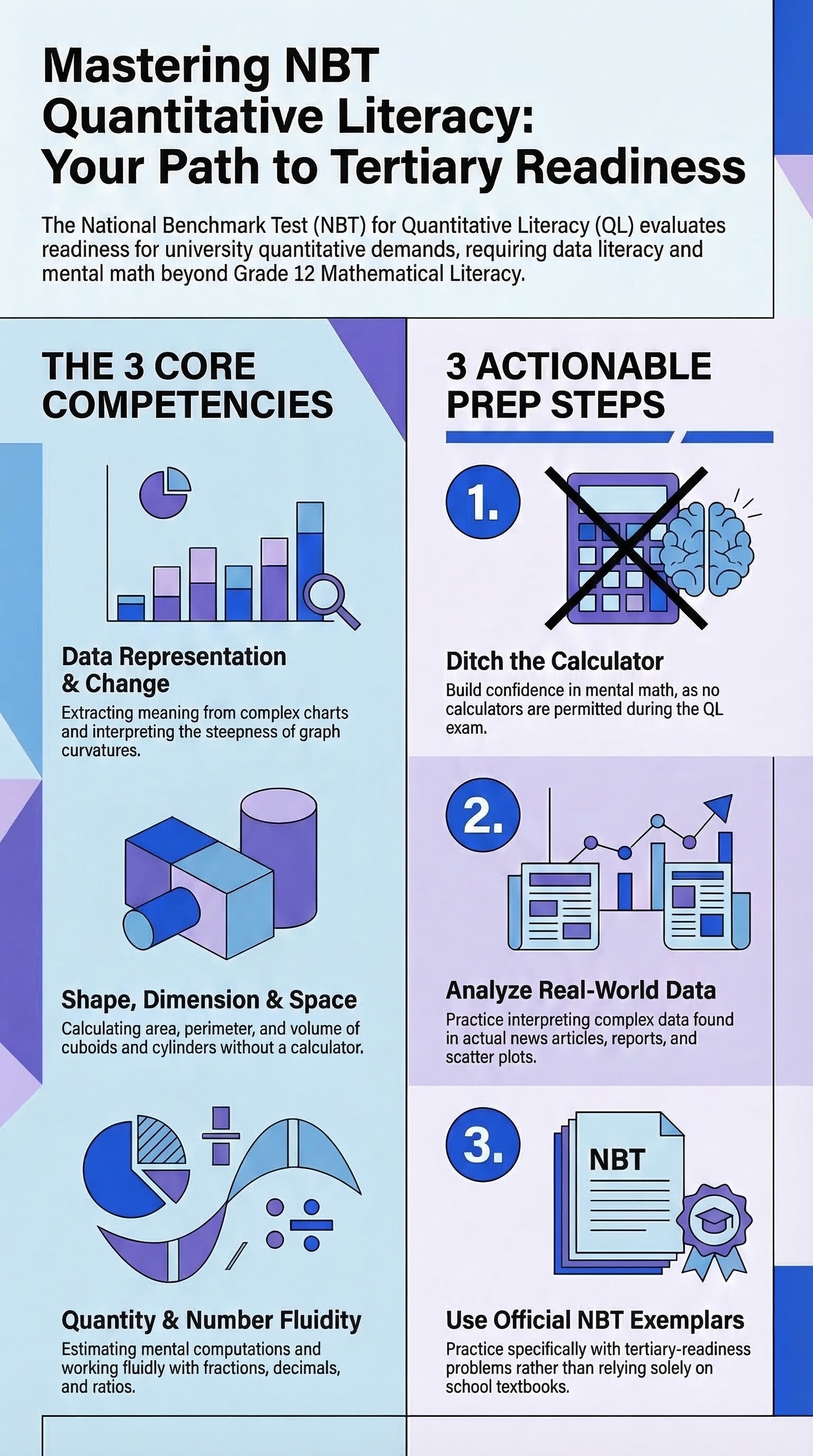
The QL test assesses your ability to manage situations and solve problems in a real-world, higher-education context using basic quantitative information. You will be tested on:
- Data representation and analysis: Extracting and interpreting data from complex tables, pie charts, scatter plots, and tree diagrams.
- Change and rates: Understanding relative changes (like percentage change) and interpreting the steepness or curvature of graphs.
- Shape, dimension, and space: Calculating area, perimeter, and volume of 2D and 3D objects (like cuboids and cylinders) without a calculator.
- Quantity and number: Working fluidly with fractions, decimals, and ratios, and estimating computations mentally.
So when you prepare for the AQL, do not assume that doing well in Mathematical Literacy at school is enough. The QL section is set in a tertiary-readiness context and demands both data literacy and confident number work without a calculator. Use the official NBT exemplars and practise interpreting real-world data in articles and reports.
Ready to put this into practice?
Our NBT courses are designed around the same strategies and content areas—with practice questions, exemplar-style tasks, and no-calculator drills.
View courses